# code-standards
_A code review that learns what your team rejects._
> Source: https://fullstack.rocks/skills/code-standards
> Code: https://github.com/Fullstack-Rocks/skills/tree/main/skills/code-standards
How many times have you left the same comment on a PR? **code-standards is a code review that learns**, so you only have to say it once.
Each review runs three layers on the changed files: your project’s linters as configured, the ast-grep rules (`cs-*`) your team taught it, and the agent’s judgment against a learned `standards.md` (`std-*`). lizard (complexity) and jscpd (duplication) run alongside, and the deterministic layers finish in under a second on about 50 files.
**Install**
Claude Code:
```shell
npx skills add Fullstack-Rocks/skills --skill code-standards -a claude-code
```
Codex:
```shell
npx skills add Fullstack-Rocks/skills --skill code-standards -a codex
```
Cursor:
```shell
npx skills add Fullstack-Rocks/skills --skill code-standards -a cursor
```
Any agent:
```shell
npx skills add Fullstack-Rocks/skills --skill code-standards
```
Prompt, to paste into your agent:
> Install the code-standards skill from https://github.com/Fullstack-Rocks/skills by running npx skills add Fullstack-Rocks/skills --skill code-standards, then set up coding standards for this repo.
`code-standards` stands alone and needs none of the other skills.
**Try saying**
- Is my change clean?
- We never read env vars outside config.
- Set up coding standards for this repo.

_[▶ Watch the recording: claude · demo shop](https://storage.googleapis.com/fullstack-rocks-media/skill-code-standards-demo.mp4) — A real Claude Code session on the demo shop, recorded as it happened. Long thinking stretches are sped up, everything else plays at its real pace._
Transcript:
```
> Is my change clean?
Skill(code-standards): the linters, the cs-* rules, lizard and jscpd, then standards.md. Every finding cites a rule.
> We never read environment variables outside app/config.py. Flag this.
Bypasses proposed before writing anything: from os import environ, import os as _os, other os.environ access, dotenv, BaseSettings subclasses, wrapper helpers, process.env / import.meta.env.
Saved: cs-env-outside-config (21 cases it must flag, 12 lookalikes it must not), cs-env-outside-config-ts (9 and 6), and std-config-single-source.
Repo hits: the Python rule flags 5 places, all real violations. These are team files, meant to be committed and reviewed in a PR.
```
## How does it work?
The config lists file extensions, not languages, so it works in any language the tools can parse. Depending on what you say, it runs in one of three modes:
1. **init** (“Set up coding standards for this repo.”) scaffolds `.code-standards/`, detects your linters and extensions, asks up to five questions, and drafts `standards.md` from 2 or 3 files you consider exemplary. Nothing is written until you approve.
2. **review** (“Is my change clean?”) runs every tool in parallel, applies only the `standards.md` entries whose scope matches, and reports by severity. Every finding cites a rule.
3. **negate** (“We never read env vars outside app/config.py. Flag this.”) first proposes the bypasses a narrow rule would miss, before touching any tools. Then it writes a rule with fixtures, saves it only once `ast-grep test` passes and a repo-wide false-positive check comes back clean, and logs it.
Everything lives in `.code-standards/` in your repo: the rules, test fixtures, standards and a log of each rejection. Your team commits it and reviews it in PRs, just like code.
```mermaid
flowchart LR
N["We never do X"]:::hi --> B[Bypasses proposed
before any tool runs]
B --> R[Rule + fixtures
after your answer]
R --> T{ast-grep test +
repo-wide check}
T -->|false positives| R
T -->|pass| S[Saved in .code-standards/
caught on every review]
classDef hi fill:var(--highlight),stroke:var(--highlight),color:var(--on-highlight)
```
_One sentence from you becomes a tested rule in .code-standards/, reviewed in PRs like code._
## But does it work?
**Benchmark · What does a review cost, and what does it find?**
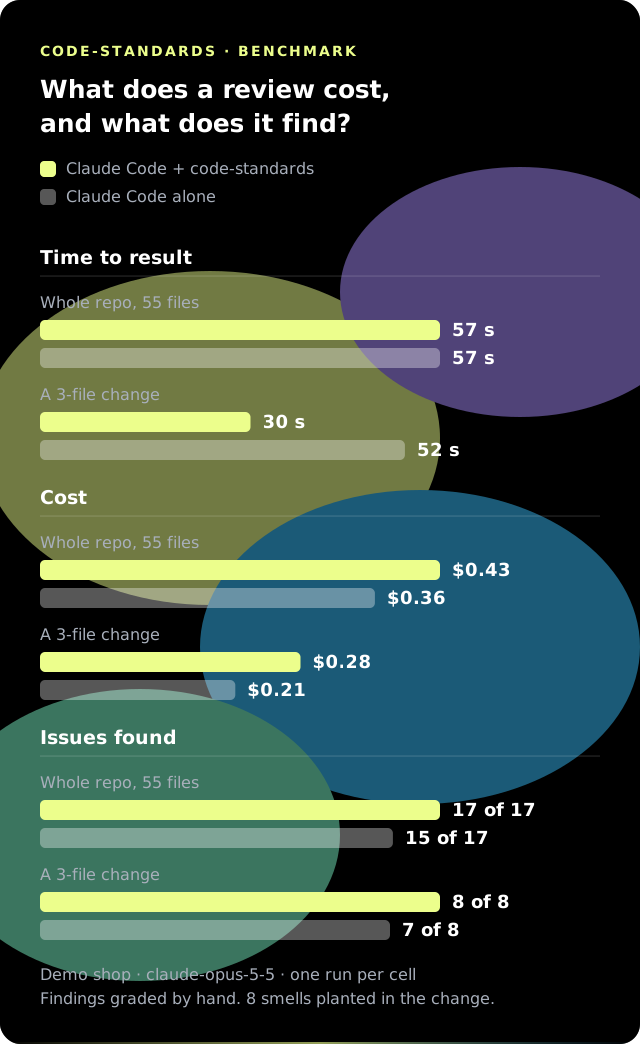
A review costs about the same with or without the skill. On the whole repo (55 files) it took 57 s and $0.43 and found 17 of 17 issues, against 57 s, $0.36 and 15 of 17 alone. On a 3-file change with 8 planted smells it took 30 s and $0.28 for 8 of 8, against 52 s and $0.21 for 7 of 8. What the skill changes is completeness. Claude alone had a shell and the project’s linters (ruff, oxlint, tsc), but no ast-grep, jscpd or lizard. Answers were graded by hand.
## The other skills
**The other skills**
- [under-engineering](https://fullstack.rocks/skills/under-engineering)
- [um-maybe](https://fullstack.rocks/skills/um-maybe)
- [under-engineering-review](https://fullstack.rocks/skills/under-engineering-review)
- [call-depth](https://fullstack.rocks/skills/call-depth)